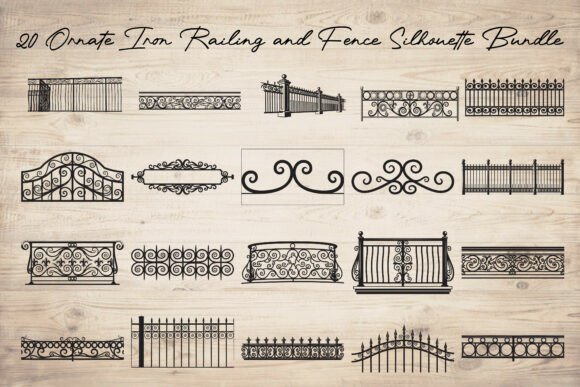
Ornate Iron Railing and Fence Silhouette
A Designer’s First Glance: Elegance with Quiet Confidence
When I opened the Ornate Iron Railing and Fence Silhouette bundle, what struck me wasn’t just the detail—it was the *intention*. This isn’t a busy filler graphic or a generic scrollwork knockoff. It carries the quiet authority of historic ironwork: balanced curves, rhythmic repetition, and subtle asymmetry that feels hand-drawn, not algorithmically generated. As an embroidery designer who’s stitched everything from monogrammed baby onesies to boutique aprons, I immediately pictured it on a linen tea towel—clean, architectural, and quietly luxurious.
Where It Lives Best: Real Projects, Real Fabric
I tested the Ornate Iron Railing and Fence Silhouette on three real-world items: a heavyweight cotton tote bag, a midweight unbrushed sweatshirt, and a 100% cotton baby blanket. On the tote, it held its shape beautifully—no distortion, no thread pooling. The silhouette’s open negative space kept stitch density manageable, which meant less puckering and cleaner stabilizer removal. On the sweatshirt, I used a medium-weight cutaway stabilizer and ran a gentle test stitch first; the design translated with crisp definition, especially along the finials and curved bars. Even on the delicate baby blanket, the clean line work avoided over-stitching—critical for something that’ll go through dozens of washes.
This is where the Ornate Iron Railing and Fence Silhouette shines: as a versatile anchor for handmade product lines. Think embroidered pillow covers for a modern farmhouse nursery, minimalist patches for denim jackets, or subtle corner accents on kitchen towels sold at craft fairs. It also works well in printable mockups—its strong outline and consistent weight make it highly legible even at small sizes (e.g., 3" wide), which matters when Etsy sellers need clear digital previews.
Where to Pause—and Why
That elegance comes with boundaries. I wouldn’t recommend this Ornate Iron Railing and Fence Silhouette for tiny hoops under 4×4 inches without simplifying first—the fine scrollwork near the base can lose clarity. On stretchy fabrics like jersey tees or curved surfaces like caps, the linear rhythm of the railing risks distorting if hooping isn’t precise. And while the silhouette reads well on light fabric, I’d avoid dense black thread on dark backgrounds unless you’ve confirmed contrast in your actual thread palette—some satin-stitched sections may fade visually without careful color pairing.
Also worth noting: this is an Illustrations-class asset—not an applique design or layered embroidery file. That means it relies entirely on stitch type and density for dimension. If your machine struggles with tight fill stitch transitions or if your stabilizer shifts easily, those delicate intersections (like where vertical bars meet horizontal scrolls) may need a slight manual cleanup post-stitch. Always test on scrap fabric first—not just for fit, but to see how thread tension interacts with your chosen fabric texture.
Practical Notes Every Embroidery Designer Should Keep Handy
- Test before committing: Run a full-size stitch-out on scrap fabric matching your final project’s weight and weave—even if it’s “just” a tote bag. Thread pull and stabilizer show-up vary more than most assume.
- Check contrast early: View the Ornate Iron Railing and Fence Silhouette in grayscale mockups against both light and dark backgrounds. What looks elegant on screen may vanish on charcoal linen.
- Stabilizer isn’t optional—it’s part of the design: Medium cutaway for knits, tear-away for stable wovens, and lightweight fusible for delicate items like baby blankets. Skip this, and the fine lines sag.
- Thread colors change perception: A warm taupe thread softens the industrial feel; deep navy or charcoal adds gravitas. Avoid high-sheen threads unless you want a polished, almost metallic effect.
- Licensing matters for commercial use: Since this is a Graphics-type digital embroidery file, verify whether resale of finished embroidered products—or redistribution of the file itself—is permitted. Small shop owners and Etsy sellers should confirm this before listing.
How It Shapes Customer Trust and Product Value
Here’s what customers notice—even if they can’t name it: intentionality. When someone sees the Ornate Iron Railing and Fence Silhouette on a custom-embroidered apron at a local boutique, they don’t think “pretty fence.” They sense craftsmanship, attention to proportion, and a cohesive aesthetic. That builds trust faster than any tagline. For holiday embroidery or personalized gifts—say, a monogrammed pillow with this silhouette as a border—it elevates perceived value without screaming “luxury.” It feels considered, not crowded.
And for craft businesses? This design supports brand consistency across product categories. Use it on a patch, then echo the same curve in a logo lockup or packaging stamp. Its architectural neutrality means it won’t clash with florals, typography, or seasonal motifs—it frames rather than competes. That flexibility is rare in silhouette-based Illustrations, and it’s why I keep it in my go-to folder for client projects requiring quiet sophistication.
A Final Thought Before You Stitch
The Ornate Iron Railing and Fence Silhouette isn’t flashy—but it doesn’t need to be. In an era where handmade products compete on authenticity and refinement, this design delivers both. It’s the kind of asset that makes a simple tote bag feel curated, a baby blanket feel heirloom-worthy, and a small shop product feel like it belongs in a thoughtful edit—not a cluttered marketplace feed. Just remember: respect its scale, honor its structure, and always stitch with the end user in mind—not just the file.