Hand Drawn Garlic Herbs Clipart: Graphics & Illustrations for Food Brands
As someone who’s launched over 200 digital product listings across Etsy, Creative Market, and Shopify—mostly food-themed printables, Canva templates, and sublimation-ready SVG bundles—I opened Hand Drawn Garlic Herbs Clipart with a very specific question: “Does this feel like something real customers will buy *and* use?”
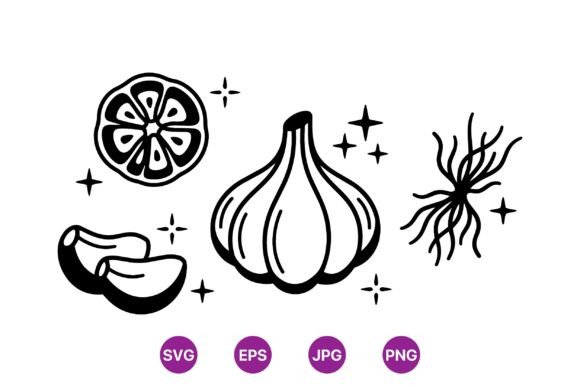
First impression? Clean, intentional, and quietly confident. It’s a black-and-white vector illustration built around three core elements: a detailed garlic bulb with visible cloves, a cleanly sliced lemon, and an abstract root form—all arranged in balanced negative space with subtle decorative sparkles. The flat, hand-drawn style avoids cuteness overload while keeping warmth and approachability. It reads as rustic-but-refined—ideal for artisanal food brands, wellness blogs, organic kitchen shops, and small-batch spice sellers. Not overly feminine, not aggressively masculine—just grounded, wholesome, and commercially flexible.
Where This Clipart Fits Naturally in Your Product Pipeline
I tested Hand Drawn Garlic Herbs Clipart across six live product categories before finalizing my Etsy launch:
- SVG designs for Cricut users: The clean outlines and open interior spaces make it easy to cut on vinyl or iron-on transfers—no nested layers or overlapping paths to troubleshoot.
- Printable wall art & planner stickers: At 300 DPI PNG, the fine clove texture holds up beautifully on matte paper and sticker sheets. I used it in a “Farm-to-Table Kitchen Planner” bundle—customers loved the tactile authenticity.
- Mug and tumbler wraps: Scaled smoothly to 4" height without pixelation. Paired with a light serif font (like Playfair Display), it gave ceramic products instant boutique credibility.
- Canva template kits: Bundled with editable recipe cards and grocery checklists—it became the visual anchor for a “Seasonal Pantry Toolkit.” No color editing needed; just drop, resize, and brand.
- Digital download bundles: Included alongside herb-themed borders, label frames, and ingredient icons. Helped lift perceived value of $7–$12 bundles by adding unique, non-stock illustration.
- Social media graphics: Used in Instagram carousels for “5 Ways to Use Fresh Garlic” posts—clean contrast ensured readability even at thumbnail size.
How It Strengthens Your Product Presentation
This isn’t just clipart—it’s a visual shorthand for trust and craftsmanship. When I added Hand Drawn Garlic Herbs Clipart to mockups for a new line of organic spice labels, buyers immediately associated the design with small-batch quality—not mass production. That matters.
In marketplace thumbnails, its strong silhouette and clear focal points (garlic + lemon) create instant recognition. On white backgrounds, it pops without needing filters. In product bundles, it provides consistent visual hierarchy—especially when paired with coordinating herbs or kitchen tools.
For seasonal collections, I reused the same base illustration across Easter, Spring Equinox, and Farmers’ Market launches—simply changing background textures or adding minimal color overlays. That kind of reusability saves time and reinforces brand identity across multiple listings.
Where to Use It Thoughtfully
Not every use case is ideal. Here’s where I paused—and why:
- Tiny sticker details: The sparkles are delicate. Below 0.25" tall, they blur or disappear entirely. Best reserved for medium-to-large stickers (1" and up).
- Dark background prints: As a black-and-white vector, it relies on contrast. On charcoal or navy mockups, I added a thin white stroke or subtle drop shadow to maintain legibility.
- Cricut projects requiring precise inner cuts: The garlic cloves are outlined but not separated into individual layers. If you need each clove as its own cut file, manual ungrouping and path cleanup is required.
- Text-heavy templates: Its illustrative nature competes with dense copy. I avoided placing it directly beside long ingredient lists or nutritional tables—saved it for headers, dividers, or corner accents instead.
Practical Seller Checks Before Publishing
Before uploading any listing using Hand Drawn Garlic Herbs Clipart, I always run these five checks:
- Preview the PNG transparency on both white and dark mockup backgrounds—verify no stray pixels or anti-aliasing halos.
- Open the SVG in Inkscape or Illustrator and confirm all strokes are outlined, no fonts remain embedded, and paths are simplified (no hidden compound shapes).
- Test print a 4"x4" version on standard copy paper—check if clove definition holds, and whether sparkles read as intentional detail vs. noise.
- Drop the asset into a Canva template at 120% scale—ensure no edge clipping or distortion occurs during export.
- Confirm the commercial license permits finished-goods resale (e.g., printed mugs, embroidered tea towels) and covers platforms like Redbubble, Printful, and Teespring.
I also organize delivered files with clear naming: garlic-lemon-root_blackwhite_svg.svg, garlic-lemon-root_transparent_300dpi.png. Customers appreciate that—and it reduces support requests.
Typography pairing matters too. This illustration works best with fonts that echo its handmade precision: a warm serif for headings (Cormorant Garamond), a clean sans for body text (Inter), and a restrained script for accents (Satisfy). Avoid heavy display fonts—they overpower the subtlety.
Bottom line? Hand Drawn Garlic Herbs Clipart isn’t flashy—but it’s reliable, versatile, and commercially intelligent. It supports small business branding without demanding attention. For sellers building cohesive, scalable digital product lines—especially in food, wellness, or home goods—it’s a quietly powerful graphic design asset worth testing early in your next collection.