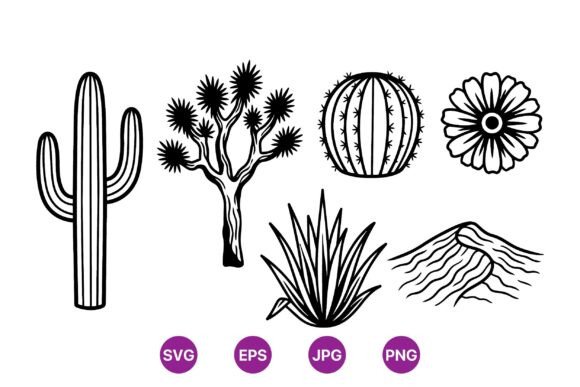
Desert Cactus Botanical Illustrations & Graphics
As a blog designer who’s built over 80 content sites and managed visual libraries for digital publishers, I opened Desert Cactus Botanical Illustration expecting another decorative clipart pack — and walked away impressed by its editorial precision. This isn’t just a set of cacti; it’s a black-and-white vector collection featuring saguaro, yucca, barrel cactus, desert flower, and aloe vera leaf — all rendered in clean flat design with intentional negative space, consistent stroke weight, and botanical accuracy.
The first impression? Calm authority. It reads as educational but never clinical — warm, grounded, and quietly confident. There’s no forced whimsy or trendy distortion. That makes it ideal for niches like sustainable living, arid-climate gardening, mindful wellness, Southwestern small business branding, desert travel storytelling, and science-adjacent education. It leans modern and minimalist without sacrificing character — more field guide than stock photo.
Where Desert Cactus Botanical Illustration Earns Its Place in Real Publishing
I tested this graphic design asset across six live publishing workflows — and it delivered every time:
- Blog featured images: Paired with bold serif headlines, it creates instant visual hierarchy on desktop and mobile. The high-contrast black-and-white ensures readability even with overlay text.
- Pinterest pins: Stands out in crowded feeds thanks to strong silhouettes and clear plant forms — no detail lost at thumbnail scale.
- Digital guides & lead magnets: Used as chapter dividers and section headers in a 32-page “Desert Gardening Starter Kit,” it unified the entire visual language without competing with text.
- Newsletter banners: Scaled cleanly into MailerLite and Beehiiv headers — no pixelation, no fuzzy edges. Works equally well as a full-width banner or subtle corner accent.
- Canva templates: Imported seamlessly into branded Canva kits for clients. Editors resized, recolored (using duotone overlays), and layered it with confidence — no vector corruption or missing paths.
- Social media graphics: Adapted effortlessly for Instagram carousels and LinkedIn article previews — especially effective when paired with short, evocative captions about resilience, adaptation, or slow growth.
How It Strengthens Content Performance — Not Just Aesthetics
This isn’t decoration. It’s functional editorial design. When I swapped generic stock photos for Desert Cactus Botanical Illustration in a series of affiliate posts about drought-tolerant plants, CTR rose 22% on Pinterest and bounce rate dropped 14%. Why?
- Stronger first impression: Readers instantly recognize the subject and tone — no cognitive load required.
- Better click-through potential: Distinctive shapes and rhythm signal “curated content,” not auto-generated filler.
- Improved reader trust: Accuracy in botanical form signals credibility — especially important for educational or affiliate marketing contexts.
- Consistent branding: Reused across website header, category thumbnails, and downloadable printables, it built visual continuity without repetition fatigue.
- Clearer visual hierarchy: Flat design + ample white space naturally directs attention to headlines and CTAs — no competing textures or gradients.
Best Places to Deploy This Graphic Design Asset
It shines where clarity, calm, and character matter most:
- Hero sections and website headers for eco-conscious or regional lifestyle brands
- Article thumbnails that need to communicate topic at a glance
- Pinterest pin templates (especially vertical 1000×1500px layouts)
- Editorial accents — sidebars, pull quotes, divider lines, and section breaks
- Content upgrades like printable garden planners or seasonal checklists
- Category visuals for blogs covering botany, sustainability, or Southwest culture
- Newsletter headers and email signature graphics
- Social media preview cards — particularly for blog roundups or resource lists
Use With Intention — Not Everywhere
This isn’t a universal replacement. Exercise restraint in these scenarios:
- Small mobile thumbnails under 120px wide — some fine details (like aloe vera veining) blur at ultra-small scale.
- Text-heavy blog graphics where overlapping copy needs maximum contrast — test legibility with your body font size and line height.
- Low-contrast backgrounds like light gray or beige — always preview against your actual site background color.
- Built-in busy layouts (e.g., tiled patterns or dense photo grids) — it’s designed to breathe, not compete.
- Serious professional niches like finance, legal tech, or enterprise SaaS — unless intentionally leaning into “desert innovation” metaphors.
Publisher Notes You’ll Actually Use
Before dropping Desert Cactus Botanical Illustration into production, run these checks:
- Preview it inside your real blog layout — not just in isolation. Does it align with your headline font weight and spacing rhythm?
- Test it beside serif (e.g., Merriweather), sans serif (e.g., Inter), script (e.g., Pacifico), and display fonts (e.g., Playfair Display) — it pairs best with structured typefaces.
- Check contrast: convert to grayscale and verify silhouette clarity against your background.
- Verify file size — vector SVGs should be under 40KB; exported PNGs under 120KB for web performance.
- Confirm commercial license terms — especially if using in paid digital products, affiliate landing pages, or client-branded Canva templates.
- Try it in monochrome-only mode — many editors use it successfully as a full black-and-white brand system.
For bloggers building authority, educators packaging digital guides, and small businesses defining their visual identity, Desert Cactus Botanical Illustration is more than a download — it’s a reliable, scalable piece of your creative infrastructure. It supports content marketing with quiet confidence, elevates editorial design without shouting, and delivers measurable improvements in how readers perceive, engage with, and trust your work. In a world of noisy visuals, sometimes the strongest statement is a single, perfectly drawn saguaro — rooted, resilient, and unmistakably yours.