Cozy Homebody Club Design
As someone who’s stitched hundreds of designs across apparel, home goods, and personalized gifts — from boutique baby onesies to Etsy best-selling tote bags — I opened the Cozy Homebody Club Design ZIP file with quiet curiosity. Not hype. Not hope. Just the steady eye of a designer who knows how easily charming illustrations fall apart under needle and thread.
A First Impression That Stays Quiet — in the Best Way
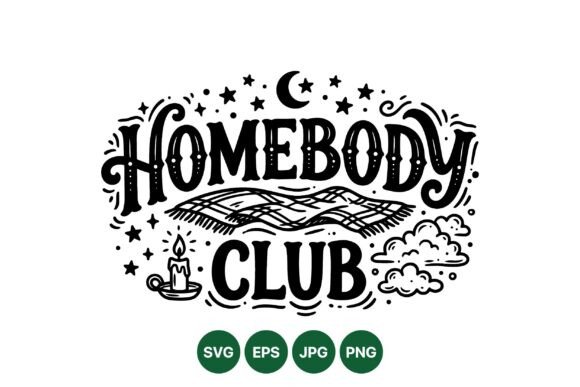
The Cozy Homebody Club Design lands softly: black-and-white, hand-drawn lettering spelling “homebody club”, wrapped in a gentle constellation of moon, stars, candle, and fluffy clouds. It doesn’t shout. It breathes. That’s its strength — and its first real test. In embroidery, mood is carried by line weight, spacing, and negative space. Here, the letterforms have just enough irregularity to feel handmade, but not so much that they’ll blur or bleed when stitched. The candle flame and cloud edges are rounded, not fussy — a relief when you’re planning satin-stitched outlines or delicate fill-stitch details.
I immediately pictured it on a heavyweight cotton canvas tote — the kind shoppers carry to bookshops and farmers’ markets. Not as a bold chest logo, but centered low on the front panel, where the relaxed composition has room to settle. It wouldn’t compete with a busy print or pattern; instead, it’d anchor the piece with warmth and intention.
Where It Shines (and Where It Asks for Care)
The Cozy Homebody Club Design thrives in projects where comfort and quiet confidence are the brand voice: embroidered sweatshirts for indie bookstores, pillow covers for cozy reading nooks, tea towels for small-batch bakeries, or nursery wall hangings where softness matters more than sharpness.
For custom apparel, it works beautifully on mid-weight fleece or French terry — fabrics that hold stabilizer well and let the design’s organic flow read clearly. On a sweatshirt embroidery project, I’d use medium tear-away + light cut-away backing to support the curves of the moon and candle without adding stiffness. The lettering is generous enough (no cramped “o”s or tight “b” counters) that even at 3.5" wide, it stitches cleanly without overloading the hoop.
It’s also a natural fit for embroidered patches — especially merrowed-edge versions meant for jackets or denim. The clean black-and-white contrast ensures legibility at small scales, and the balanced layout avoids awkward cropping if you’re trimming around the outer elements.
But — and this is where experience kicks in — tread thoughtfully on stretchy fabric like ribbed knits or lightweight jersey. Those cloud outlines and star points rely on stable ground. Without proper cut-away stabilizer and precise hooping, the hand-drawn charm can turn into wobbly distortion. Same goes for curved surfaces: skip putting this full layout on a baseball cap front unless you’re using a multi-hoop repositioning method. The moon and candle sit too close to the outer edge for standard cap hoops.
And while the Cozy Homebody Club Design reads well on dark fabric, remember that white thread won’t pop the same way black does. If your version uses white thread on navy, test stitch density first — too many fill stitches in the candle base or cloud clusters can create stiff, shiny patches. A lighter fill stitch or strategic running-stitch accents often preserves the hand-drawn air better than dense satin coverage.
What It Does for Your Craft Business — Beyond the Stitch
This isn’t just a graphic — it’s a subtle brand amplifier. For an Etsy seller or small shop product, the Cozy Homebody Club Design signals alignment with slow-living aesthetics without leaning into cliché. Customers recognize sincerity in restraint: the lack of glitter, gradients, or forced whimsy makes it feel trustworthy, not trend-chasing.
In personalized gift contexts — think baby milestone blankets or holiday embroidery kits — it adds emotional resonance. A new parent seeing “homebody club” stitched beside a tiny candle on a swaddle doesn’t just see decoration. They see permission. That kind of quiet connection lifts perceived value, supports premium pricing, and encourages repeat buyers.
It also plays well in printable mockups and digital previews. Because it’s delivered as an SVG in a ZIP folder, it scales cleanly for social media listings, product tags, and branding assets — meaning your craft business gets cohesive visuals across physical and digital touchpoints without extra design lift.
Practical Designer Notes Before You Stitch
- Always test on scrap fabric first — especially if pairing with textured weaves (like linen-look tea towels) where fine lines may sink between threads.
- Check thread color contrast early. Black thread on cream fabric? Lovely. But black on charcoal? Might need a slight size bump or bolder outline.
- Review stitch density in your embroidery software. If the original file wasn’t optimized for stitching (and SVGs rarely are), simplify cloud clusters or reduce fill layers in the candle wax area to avoid puckering.
- Confirm hoop size compatibility. This design fits comfortably in a 4x4 hoop at standard scale — but if you’re enlarging for a pillow cover, verify your machine’s max stitch width and adjust stabilizer accordingly.
- Inspect small details at actual stitch size: the tip of the candle flame, the curve of the crescent moon, the spacing between “club” and the nearest star. These define clarity.
- Test in black-and-white mockups — no color distractions. Does the hierarchy hold? Does “homebody club” still dominate visually?
- Use proper stabilizer for your fabric type. Don’t assume lightweight cut-away will hold the candle’s base on fleece — sometimes medium-weight is safer.
- Verify licensing before selling finished items or bundling the Cozy Homebody Club Design into digital embroidery kits. Since it’s categorized under Illustrations and Graphics, confirm whether commercial use is included — many hand-drawn SVGs require extended licenses for resale.
The Cozy Homebody Club Design won’t wow with flash. It wins with presence — the kind that makes someone pause mid-scroll, smile faintly, and click “add to cart.” That’s rare. And for makers building something real — not just products, but moments — that quiet resonance is worth every careful stitch.